
Just a little while ago, the Golden State Warriors seemed inevitable.
Two days removed from a grueling seven-game battle with the Houston Rockets, the Warriors went into Target Center and defeated the well-rested Minnesota Timberwolves in Game 1 of the Western Conference Semifinals.
The multi-time champions looked primed to make yet another deep playoff run.
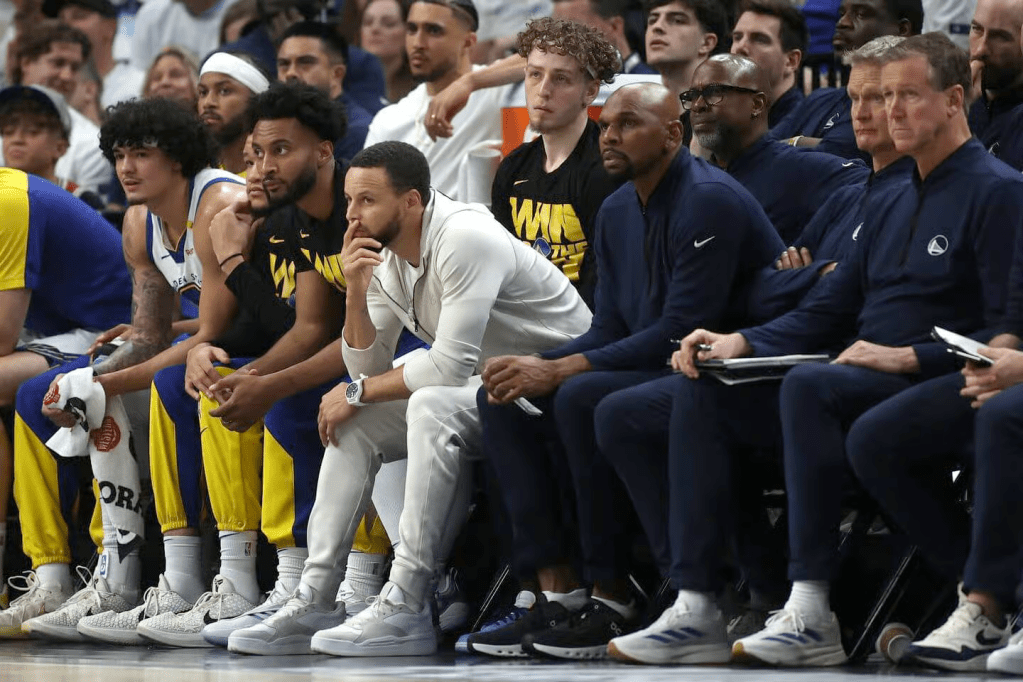
Then suddenly, Stephen Curry went down.
And then suddenly, so did Golden State’s championship hopes.
The belief within the organization was that Curry could return from his hamstring injury for Game 6 if they could just hold off Minnesota for one game.
They failed to do so.
Not only did they lose four straight games in Curry’s absence, but they also trailed by 15 or more points in each one.
We have seen teams win games in these playoffs without a star player. The Celtics managed to win a game without Jayson Tatum. The Cavaliers won multiple games without Darius Garland.
So, why couldn’t the Warriors win without Stephen Curry?
The Absence of the “Curry Effect”
If Steve Kerr and his revolutionary offense are the brains of the Warriors’ operation, then Curry is the heart that makes the whole thing run.
Despite roster limitations on both this Golden State team and previous ones, they maintain offensive efficiency and game competitiveness through their ability to create quality opportunities for role players.
The biggest reason for their constant offensive effectiveness comes from the “Curry effect.”
In the Curry era, tons of role players have been effective in Golden State playing with him. Just in the previous three years, guys like Andrew Wiggins, Jordan Poole, Donte DiVencenzo, Otto Porter Jr. and Gary Payton II played arguably their best basketball with the Warriors and declined after leaving them.
This 2025 team was no different. Players like Buddy Hield, Brandin Podziemski, Moses Moody and even Jonathan Kuminga stepped into sizable roles. They get to play freely in the Warriors’ offense and get a lot of great open looks.
The reason? Steph Curry was being double and triple-teamed on AND off the ball.
What separates Curry from everyone else beyond being the greatest shooter ever is the fact that he is such a threat without the ball, he often has multiple defenders following him around the court, even without the ball.
In the Rockets’ series, almost every time Curry got the ball or an on-ball screen, they double-teamed him beyond the arc and had a third player lurking near the paint to step up if needed. For off-ball screens, they promptly switched and stayed with him every time.
What did this open the door to? Easy shots, efficient field-goal percentages, and even numerous 25-30 point games from Hield, Poziemski, and Jimmy Butler III.
What happened without the “Curry effect” in the Timberwolves series? Diminished-quality looks and diminished offensive production.
Poor Play from Supporting Cast
In the first round against the Rockets, the Warriors got outstanding contributions from role players in key moments throughout the series.
Buddy Hield shot 47.5 percent from the field. He also scored 33 points and hit a record nine three-pointers in Game 7.
Draymond Green played outstanding defense on Alperen Sengun—one of the best post players in the league—including a game-sealing stop while effectively orchestrating the offense.
Although Brandin Podziemski struggled a bit, he dropped a team-high 26 points in a pivotal Game 4.
None of those guys replicated their production in the second round despite the increase in minutes.
In fact, all of Golden State’s role players underperformed in the Timberwolves series. They all had lower field-goal percentages, lower point totals, and more scoring droughts throughout the series except for Jonathan Kuminga, who didn’t even have a spot in the rotation a week ago.
Even Draymond Green, their best and most consistent defender, underacheived in his role.
Kerr’s job was exponentially more difficult without Curry because of this. It was almost impossible to find a reliable rotation with the way this team is constructed.
Fourteen players saw the floor in Game 2—an astronomical number, especially for a playoff game.
It doesn’t take a genius to know that’s not the situation that you want to be in Game 2 of a playoff series.
That’s what the preseason is for. That’s what the 82-game regular season is for. In reality, that’s what the entire calendar year is for EXCEPT April, May and June.
No team is going to be the same without its best player. But if you have to figure out how to look like a competent professional basketball team because your star got hurt, that’s a pretty good indication that the roster is flawed.
This team lacks size, athleticism, defense, young talent and additional shot creators outside of Butler. There are many things that this team is missing and the lack of balance is what made it so hard to adjust.
Jimmy Butler III’s Passive Play
Let’s address the uncomfortable elephant in the room for Warriors fans: Jimmy Butler was a huge disappointment in this series.
A few weeks ago, Butler called himself the Robin to Curry’s Batman. And I don’t blame him: There’s nothing wrong with being a sidekick to Steph.
But he clearly doesn’t realize that the Warriors traded for him and gave him a two-year, $111 million dollar contract extension to be Batman when needed. And with Curry’s absence, they absolutely needed him to be Batman.
Warriors fans weren’t the only ones expecting Butler to be “Playoff Jimmy.” The team also clearly was expecting better showings from him.
Butler led the team in minutes per game and total minutes throughout Golden State’s playoff run with 36.3 and 436 respectively. One of Kerr’s adjustment attempts was to run his offense through Butler.
In a post-game press conference after the Warriors’ stole Game 1 in Minnesota, Green was quoted saying “Jimmy’s capable of carrying the team. He carried a team to the Finals twice, so we won’t panic. We’ll figure out what that means.”
It turned out to mean almost nothing.
The main problem wasn’t necessarily his play—though he did miss more uncharacteristic layups and open shots than usual.
The real issue was his lack of aggression.
When you are the first option on any team let alone a playoff team, you should be taking at least 20-25 shots a game. Even if the shots aren’t falling, at least you can produce by getting to the free-throw line.
Butler didn’t even lead the team in field-goal attempts in multiple games.
Taking 13 or fewer shots in three out of four games will not lead to star-level production. You’re not going to open up opportunities for your teammates either.
In a series against a team with a clear superstar in Anthony Edwards, the Warriors needed Butler to step up and be their superstar. But he never shifted out of the “Robin” mindset.
Because he didn’t rise and lead the charge, the Warriors got gentlemen swept.
The Bottom Line
Without Stephen Curry, the Timberwolves are simply a better basketball team than the Warriors. Period.
The T-Wolves’ roster is deeper, bigger, stronger, faster, more efficient on all three levels, and features the best player in the series by far.
Most importantly, they know exactly who they are.
Without Curry, the Warriors do not.
Ultimately, there is nothing that the Warriors do better on the court than the Minnesota Timberwolves if Stephen Curry is in street clothes—even when they aren’t playing their best basketball.
If the Warriors are serious about competing for championships moving forward, general manager Mike Dunleavy Jr. and the front office have a lot of work work to fix this team’s major issues.
 Deshaun Clayborne Media